
Introduction to Lean Startup
The Lean Startup methodology has fundamentally changed how entrepreneurs approach new product development and business creation.
This approach offers a systematic alternative to traditional lengthy planning cycles, promising to reduce the inherent risks of starting a business. How does the lean startup approach actually minimize startup risk while accelerating success?

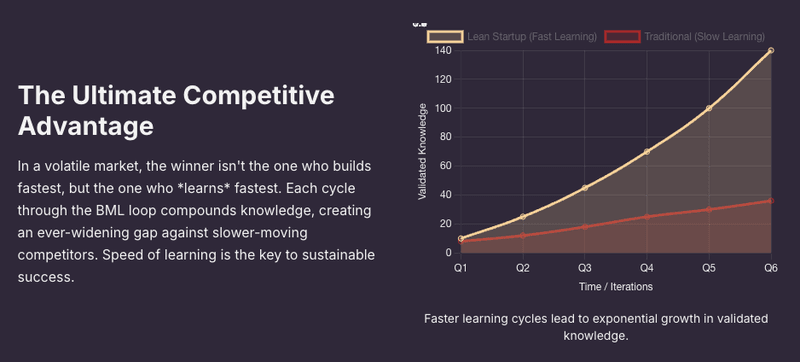
The Lean Startup methodology systematically reduces entrepreneurial risk by prioritizing rapid learning over rapid building through continuous experimentation and validation.
The methodology shifts entrepreneurial focus from speed of building to speed of learning.
- Rapid cycling through Build-Measure-Learn loops directly correlates with risk reduction
- The ultimate competitive advantage becomes how quickly teams can validate assumptions
- Each iteration converts uncertainty into actionable knowledge through small-scale experiments
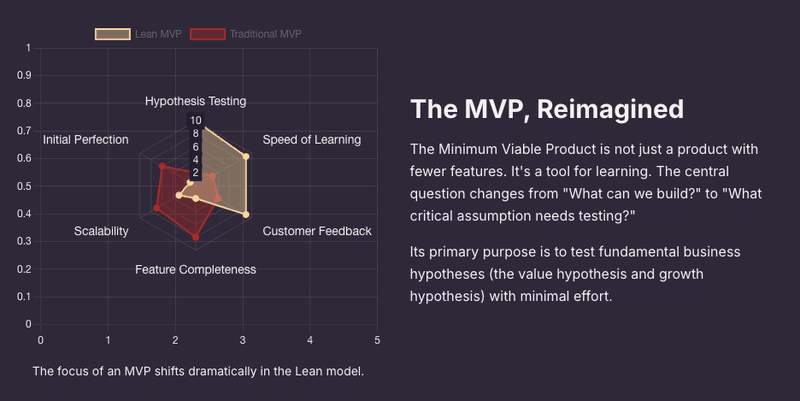
MVPs function primarily as hypothesis validation tools rather than simply minimal products.
- The "learning" function takes precedence over the "product" aspect in MVP design
- Design decisions should be driven by specific hypotheses requiring validation
- The goal shifts from "What features can we remove?" to "What critical assumption needs testing?"
The Build-Measure-Learn loop systematically converts business uncertainty into validated knowledge.
- Building creates testable experiments through MVPs
- Measuring collects relevant data on user interactions and product effectiveness
- Learning analyzes results to make informed decisions about iteration or pivoting
Validated learning prevents wasteful resource allocation on unproven customer assumptions.
- Structured experiments test business hypotheses with real customer data
- Early identification of flawed assumptions prevents larger, costlier mistakes
- Even negative results provide vital information for future strategic decisions
Lean Startup integration creates targeted resource optimization
- Resource scarcity challenge: Startups operate with constrained budgets and limited time
- Strategic filtering: Shifts focus from doing things efficiently to efficiently doing the right things
- Waste elimination: Prevents resource dissipation across less impactful activities
- Outcome maximization: Directs finite capital toward activities generating validated learning and market traction